Livestock ventilation is one of those loads that never takes a day off. Fans run through the hottest hours of summer, through humid nights, and through the power interruptions that rural grids occasionally deliver. The electricity bill reflects it—and so does the risk when the grid drops during a heat event.
A PV-ready fan control cabinet changes the arrangement. Instead of treating solar as a separate add-on project, it puts solar, grid, and fan control in one enclosure, wired to work together from day one. Solar is consumed first. The grid covers the gap. And when the grid goes down during daylight, the fans can keep running on whatever sunlight is available.
This article walks through what the cabinet does, how each function works in practice, and the boundary conditions engineers and integrators should confirm before specifying one.
What Is a PV-Ready Fan Control Cabinet?
It's a single enclosure that combines three things that are usually purchased and wired separately:
· An MPPT energy manager (TS or HS series) that tracks the solar array and regulates PV output to a stable DC voltage
· Multi-channel motor drive electronics for 3–6 fans, with individual circuit breakers and distribution terminals
· Ventilation control and monitoring—either built in or connected to an existing climate controller via RS-485
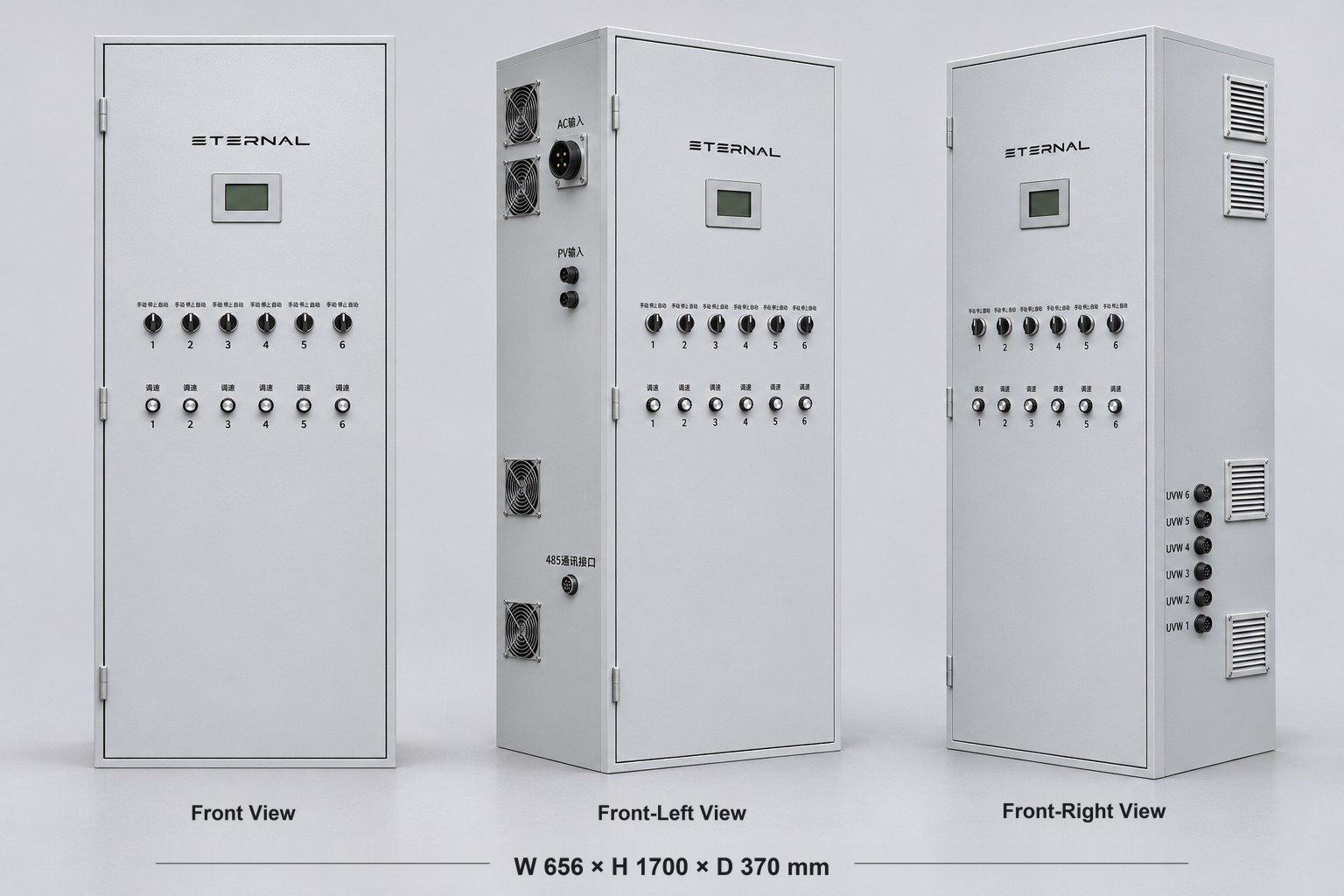
The solar array feeds the cabinet. The grid feeds the cabinet. The fans connect to the cabinet. Inside, solar and grid couple on the drive DC bus, and each fan gets its own controlled output.
Solar First, Grid as Backup: How the Energy Flows
The operating logic is the same DC-coupling principle used across solar direct-drive systems, packaged for multi-fan sites.
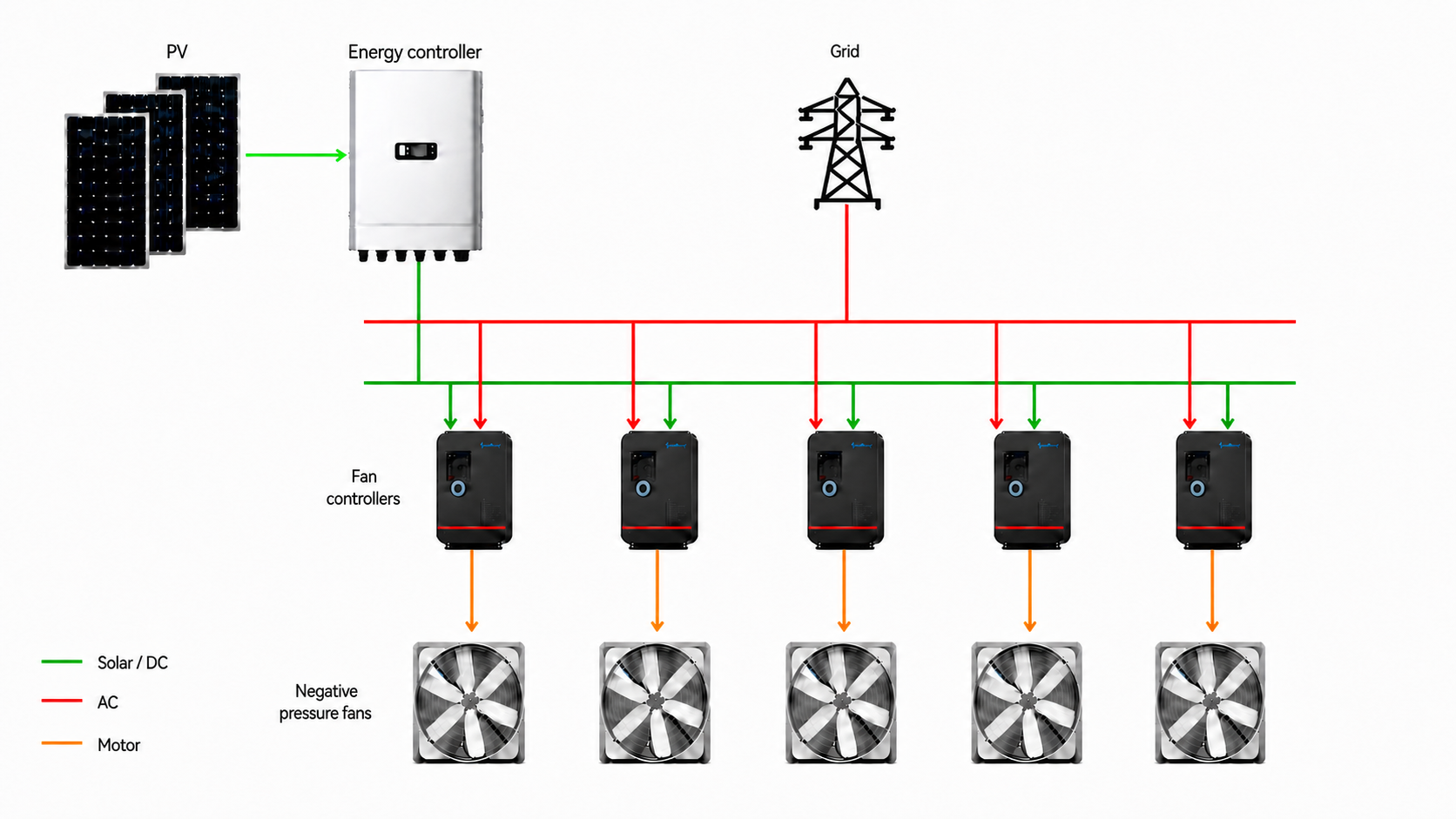
The MPPT energy manager holds the solar-side voltage slightly above the grid-rectified bus voltage. As a result:
· Strong sunlight → Solar voltage is higher → PV energy supplies the fans first
· Clouds or low sun → Bus voltage dips → Grid rectification fills the deficit in real time
· Night → Fans run on grid power, exactly as they would in a conventional installation
This is continuous power superposition on a shared DC bus, not a contactor flipping between sources. Fan speed stays stable through passing clouds because the grid is always connected and always ready to cover the difference.
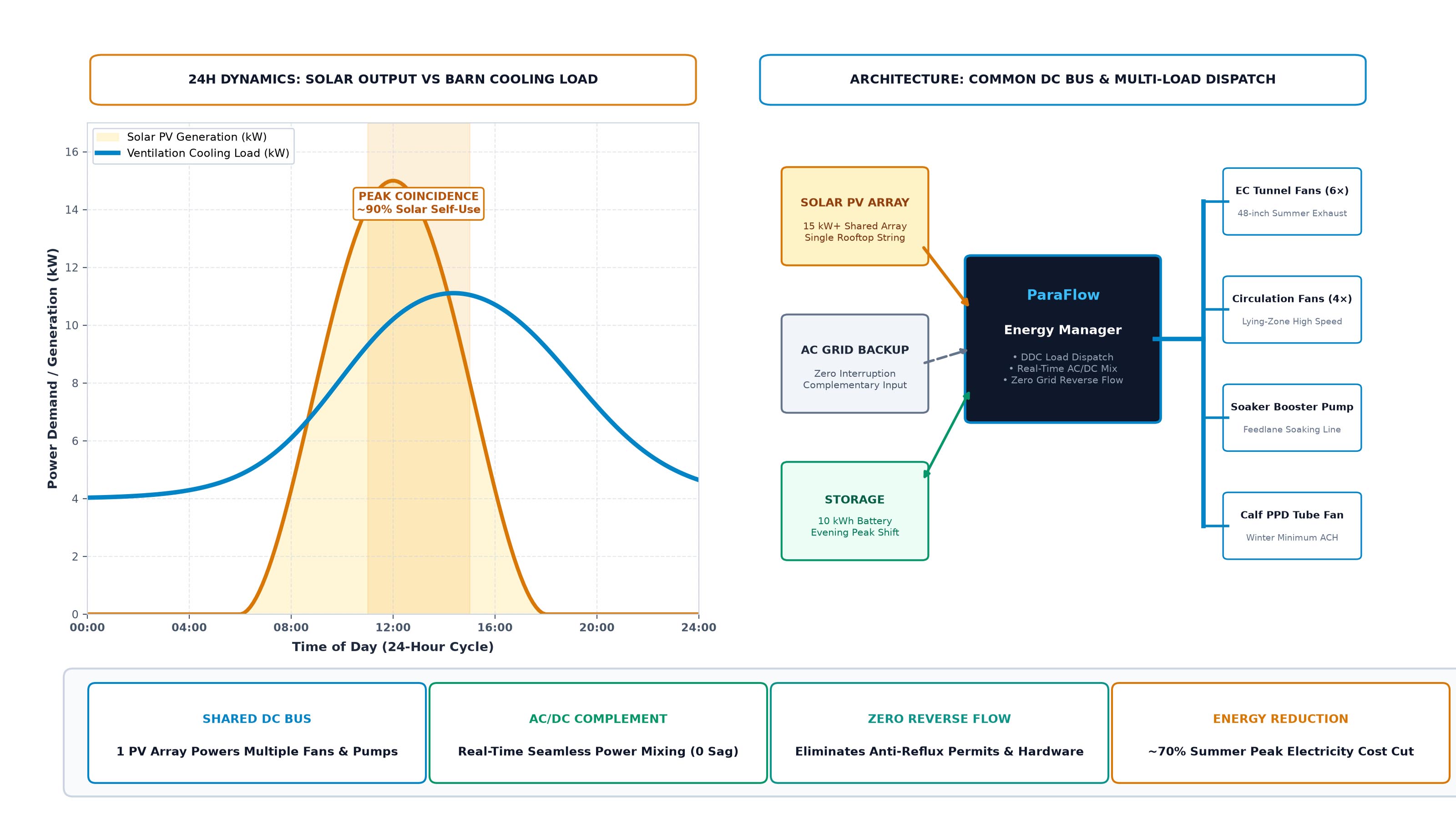
The practical benefit: every kilowatt-hour the array produces during daylight displaces purchased electricity, while ventilation settings remain exactly where the operator set them.
When the Grid Drops, Daylight Still Moves Air
This is the function that gets the most attention—and deserves the most careful explanation.
In a battery-free configuration, if the grid fails during daylight and irradiance meets the system's minimum operating conditions, the cabinet continues running the fans on available solar power, adjusting speed to match what the array can deliver. That keeps air moving during an outage and buys time for emergency response—generator start-up, load shedding, or manual intervention.
What this is: solar-following ventilation during a grid outage, within the limits of available sunlight.
What this is not: a guarantee of full-speed ventilation without storage, or nighttime operation without a battery. Output tracks irradiance. Below the minimum operating threshold, the system follows its protection logic—reducing load, pausing, or waiting for conditions to recover.
Boundary condition: Solar-following operation requires minimum irradiance conditions. Do not specify this function as "runs at full airflow during any outage" or "works at night without storage."
Storage-Ready Without Being Storage-Dependent
The cabinet works without a battery. It also accepts one when the project needs it.
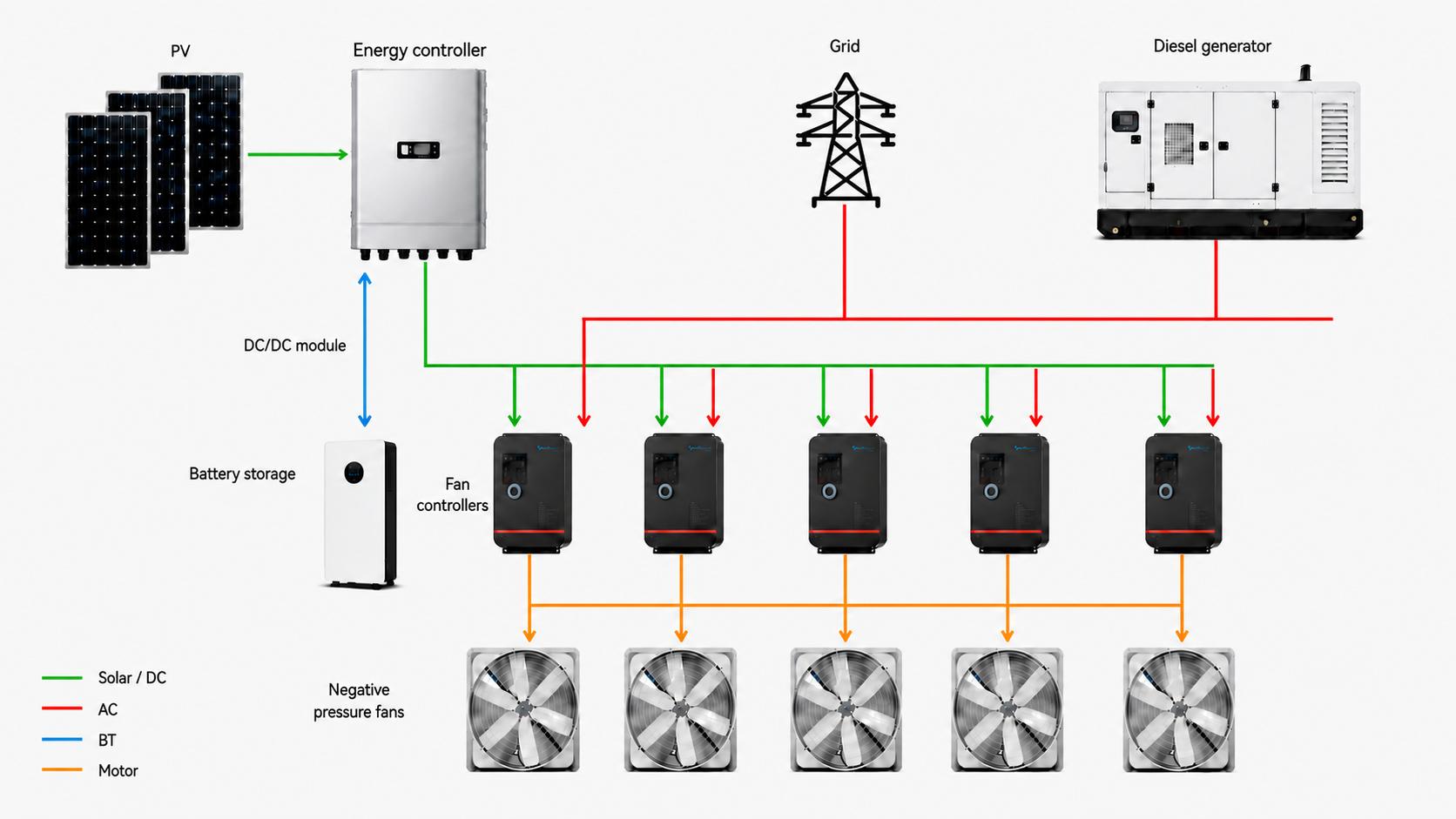
An optional DC/DC module connects a battery bank to the system, extending ventilation through low-light periods and nighttime outages. For facilities that already own a storage system, the cabinet can be adapted to work with it—reusing existing investment rather than replacing it.
Compatibility is the operative word. Existing storage must be matched on voltage, interface, and control protocol. This is an engineering match, not a universal adapter.
Boundary condition: Existing storage integration requires verified voltage, interface, and protocol compatibility. Do not describe the cabinet as plug-and-play with any storage system or as providing zero-delay source transfer.
| Configuration | Daytime, grid up | Daytime, grid down | Night, grid up | Night, grid down |
| No storage | Solar first, grid fills gap | Solar-following within irradiance limits | Grid power | Fans stop per protection logic |
| With storage | Solar first, surplus may charge | Solar plus stored energy, subject to design | Grid power; storage available per strategy | Storage-powered, duration depends on capacity and design |
Table is a qualitative description of operating states. Actual behavior depends on system design, storage sizing, and control configuration.
One Cabinet, New Fans or Existing Ones
Retrofit is where most livestock facilities actually start. Replacing every fan is rarely the first move—replacing the control and drive package is.
The cabinet's multi-function motor controller supports both AC motors and permanent magnet motors. That means:
· New installations can specify the cabinet with matched fans from the start
· Existing houses can keep compatible fans in place and upgrade the drive and control layer
· Mixed populations—some AC, some permanent magnet—can be managed from the same cabinet where the motors are compatible
This is what "PV-ready" should mean in practice: the solar conversion and the motor control arrive together, rather than as two projects separated by a year.
Multi-Fan Management in a Single Enclosure
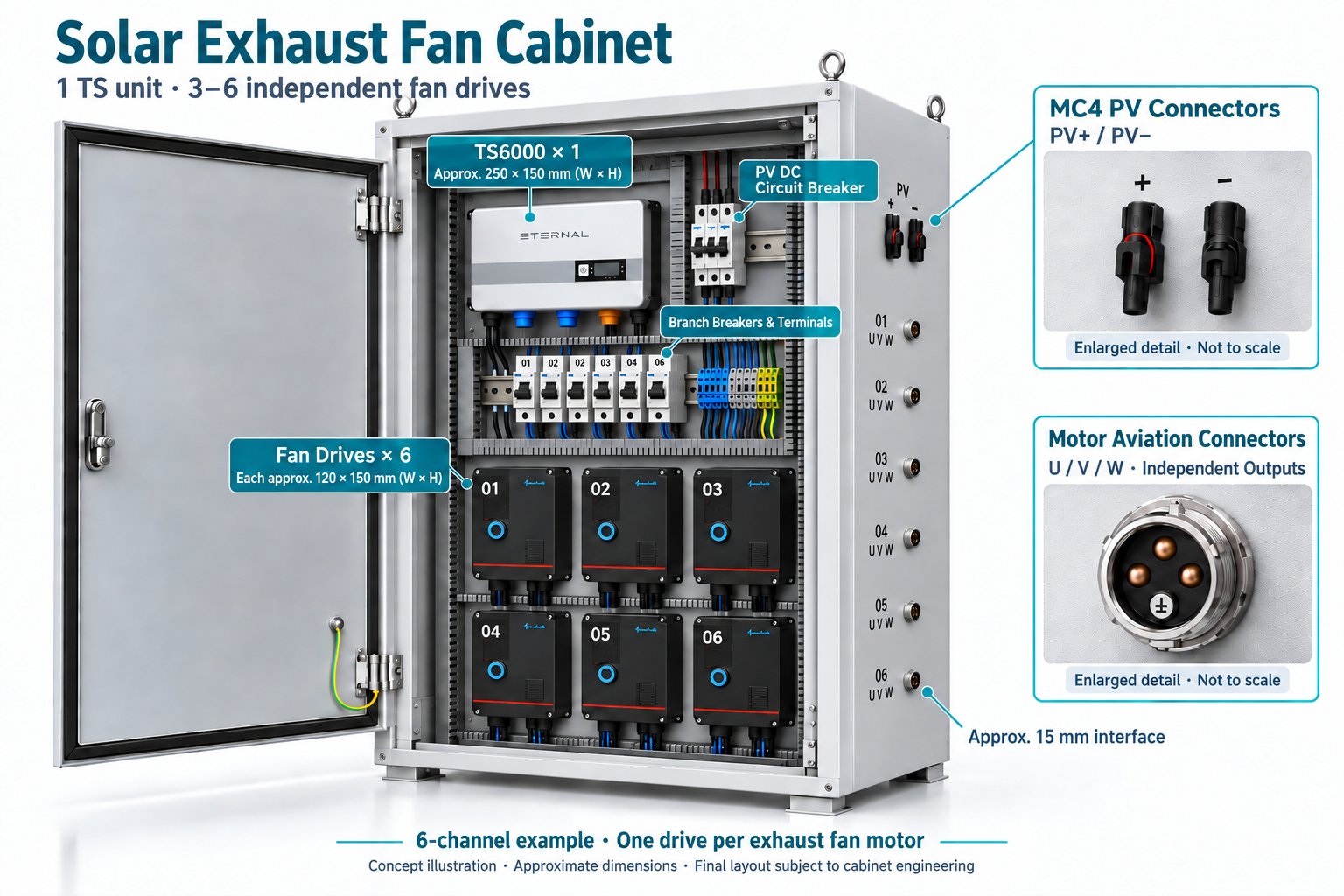
The cabinet integrates a TS or HS energy manager and provides 3 to 6 independent drive channels, each with its own circuit breaker and distribution terminals.
| Feature | What it means on site |
| 3–6 independent channels | Each fan has its own protected output and control |
| Individual breakers | Service one fan without shutting down the cabinet |
| Shared energy manager | One solar input serves the whole fan group |
| Centralized distribution terminals | Fewer external enclosures, simpler wiring |
| Consolidated control | Start, stop, and speed set per fan from one interface |
For a tunnel-ventilated house with four or six fans, this replaces a wall of separate drives, breakers, and junction boxes with one coordinated assembly. Installation time drops, and maintenance access improves—one panel to open, one set of terminals to trace.
Built for the Reality of a Livestock House
Livestock environments are hostile to electronics. Evaporative cooling pads and fogging systems put fine water mist and aerosols in the air. Dust, ammonia, and humidity are constant.
Two design choices address this:
· Backplate heat dissipation for the drive and control electronics—heat moves into the cabinet structure rather than relying solely on internal air movement
· Optional IP65 enclosure rating for installations where spray and aerosol exposure is significant
IP65 is an option, not a standard across the range, and it should be specified based on the actual environment rather than assumed.
Boundary condition: IP65 is an optional enclosure design. Do not present it as standard across all models or as a certified rating unless the specific configuration has been verified.
Connecting to the Climate Controller You Already Use
Ventilation in a modern livestock house is rarely managed fan-by-fan. It's staged by a climate controller responding to temperature, humidity, and static pressure.
The cabinet fits into that structure in two ways:
· Built-in climate control for facilities that want the cabinet to manage staging directly
· RS-485 connection to an existing climate controller, so the cabinet receives start, stop, and speed commands and reports status back
Either way, the goal is the same: the operator sets ventilation strategy in one place, and the cabinet executes it—with solar contributing whatever it can and the grid covering the rest. No walking the house to adjust individual fans.
Everything Visible at a Glance
The cabinet uses a sloped display panel on a lightweight enclosure, positioned for reading at standing height.
The screen consolidates:
· Energy composition—how much is coming from solar versus grid
· Status of each connected fan—running, stopped, speed level
· System conditions relevant to operation and troubleshooting
· For daily checks during a heat event, this matters. An operator can confirm at a glance that fans are running and see whether solar is carrying the load or the grid is doing the work.
Specification Checklist
Before finalizing a PV-ready cabinet for a project, confirm:
1. Fan count and motor type — how many channels, AC or permanent magnet
2. Per-fan power ratings — drive sizing against actual motor nameplate
3. Solar array size and string voltage — within the energy manager's MPPT window
4. Grid supply — voltage, phase, and available capacity
5. Storage intent — none, optional DC/DC module, or integration with existing storage (verify voltage, interface, protocol)
6. Minimum irradiance for solar-following operation — confirm against local climate and the facility's outage expectations
7. Enclosure rating — standard or optional IP65 based on spray and aerosol exposure
8. Climate controller interface — built-in control or RS-485 to existing system; confirm protocol
9. Protection and isolation — per-channel breakers, DC-side protection, service isolation
10. Local electrical code — disconnect, grounding, and DC-side requirements
The Takeaway
A PV-ready fan control cabinet doesn't ask a livestock operation to choose between solar and reliability. It puts solar first when the sun is up, keeps the grid connected as the always-available backup, and—when irradiance allows and the grid fails—keeps air moving on sunlight alone.
The engineering is in the boundaries: solar-following needs light, storage integration needs matching, and IP65 is a choice rather than a default. Get those right, and the cabinet delivers what the name promises—a ventilation system that's ready for solar from the day it's installed.
FAQ
1. Does the cabinet work without a battery?
Yes. In the basic configuration, solar supplies the fans first and the grid covers the deficit in real time. No storage is required for normal operation.
2. What happens to ventilation if the grid fails during the day?
If irradiance meets the minimum operating conditions, the fans continue running on available solar, with speed following PV output. This is not a guarantee of full airflow—output tracks sunlight, and the system follows protection logic when conditions fall below threshold.
3. Can I connect my existing battery system?
The cabinet can be adapted to work with existing storage, provided voltage, interface, and control protocol are matched. This is verified per project—it is not a universal plug-and-play connection.
4. Can I keep my existing fans?
If the existing fans use compatible AC or permanent magnet motors, the cabinet can drive them while upgrading the solar and control layer. Motor compatibility is confirmed during specification.
5. How many fans can one cabinet control?
Three to six independent channels, each with its own breaker and distribution terminals. Channel count and per-channel power rating are confirmed against the actual fan schedule.
6. Does it feed power back to the grid?
No. Solar feeds the drive DC bus and is consumed by the fans on site. The system is not a grid-connected generator and does not export power.