Water pumps run around the clock in industrial plants, commercial buildings, and agricultural operations—circulating coolant, boosting pressure, irrigating fields, and keeping pools clean. They're also among the most energy-intensive loads in any facility. In fact, pumping systems account for 20–30% of industrial electricity consumption in many regions.
What if the sun could power those pumps directly—without batteries, without a separate solar inverter, and without the conversion losses that plague
traditional solar setups?
That's the promise of full DC architecture applied to pump systems. By feeding solar energy directly into the pump drive's DC bus, this approach delivers solar priority with seamless grid backup, cuts conversion losses, and leverages an often-overlooked advantage: water itself as a natural energy buffer.
Here's what engineers, facility managers, and agricultural operators need to know.
What Is Full DC Architecture for Pumps?
Most modern pumps are driven by variable frequency drives (VFDs) or permanent magnet motor drives. These drives already contain a DC bus—the intermediate stage between AC rectification and motor inversion.
Full DC architecture connects solar directly to that DC bus.
Solar path: PV DC → MPPT energy manager (HS/TS) → DC/DC regulation → Pump drive DC bus → Motor
Grid backup: Grid AC → Pump drive internal rectification → Same DC bus → Motor
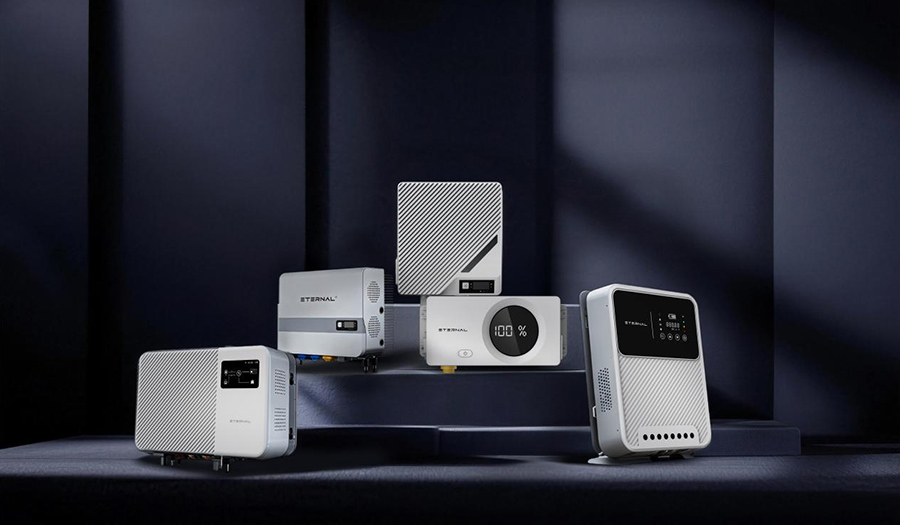
An MPPT energy manager (like Eternal's HS/TS series) tracks the solar array's maximum power point and stabilizes the output to match the pump drive's bus voltage. The grid remains connected through the drive's existing rectifier. When solar voltage exceeds the grid-rectified voltage, solar takes priority. When solar drops, the grid fills the gap in real time on the same bus.
No separate solar inverter. No batteries required. No reverse feed to the grid.
Why Pumps Are an Ideal Fit for DC Coupling
1. VFDs Are Already Standard
Pumping is one of the most common VFD applications. Variable speed control is widely used for flow regulation, energy savings, and soft starting. That means the DC bus is already there—waiting for solar input.
2. Load Profiles Match Solar Generation
Many pump applications run during daytime hours:
l Irrigation pumps operate during daylight
l Pool circulation runs during pool hours
l HVAC cooling pumps run harder when the sun is hottest
l Industrial process pumps often run continuously through the day
l This natural alignment means solar energy gets consumed as it's produced.
3. Variable Speed Enables Solar Tracking
Pumps are inherently variable-speed loads. Flow and head can be adjusted across a wide range. This allows the pump to track available solar power—increasing output when the sun is strong, reducing speed when clouds pass, while still meeting minimum process requirements.
4. Water Bodies Provide Free "Storage"
This is the unique advantage of pump systems: water itself can buffer energy. Tanks, reservoirs, pools, and ponds let you store solar energy as water volume or water level—no batteries required. More on this below.
Typical Applications
| Application | Pump Type | Why It Fits |
| Industrial circulation | Centrifugal pumps, HVAC cooling pumps | Long daytime run hours; VFD-driven |
| Commercial buildings | Booster pumps, pressure maintenance | Daytime occupancy and cooling demand |
| Swimming pools | Pool circulation pumps | Daytime operation; water body as buffer |
| Agriculture | Irrigation pumps | Peak demand matches peak solar |
| Aquaculture | Aeration pumps, circulation pumps | Daytime oxygen demand aligns with solar |
Operating Logic: Solar Priority, Grid Backup
The control logic is elegantly simple.
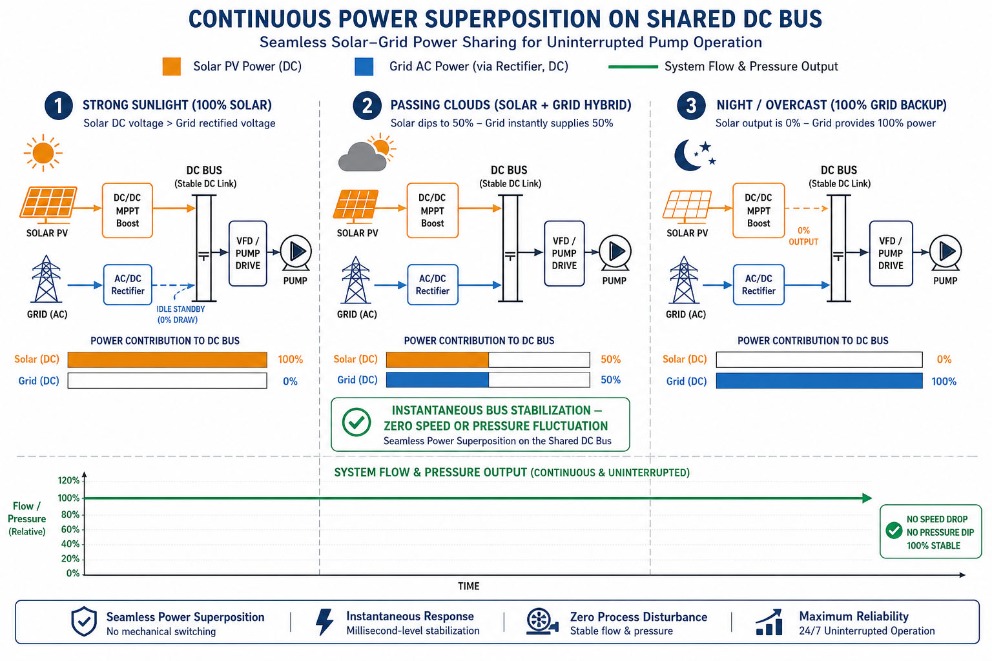
The HS/TS MPPT energy manager stabilizes the solar-side voltage slightly above the grid-rectified bus voltage. As a result:
l Strong sunlight → Solar voltage is higher → PV energy powers the pump
l Passing clouds → Bus voltage dips → Grid rectification fills the gap instantly
l Night or heavy overcast → Pump runs on grid power, just like a conventional system
This is continuous power superposition, not a mechanical switch. The pump doesn't see a sudden transfer between sources. Flow stays stable. Pressure stays stable. And because the grid is always on standby, solar intermittency never reaches the load.
For critical pumping—like cooling water or process feed—this reliability is essential. The pump keeps running regardless of weather.
The Water Buffer: Free Energy Storage Without Batteries
One of the most compelling advantages of DC-coupled pump systems is the ability to use water bodies as non-electrical storage.
Instead of storing excess solar energy in batteries, you store it as water:
l Irrigation: Pump more water during peak sun into a storage tank or reservoir. Use it later when the sun isn't shining.
l Pool circulation: Run the pump longer during sunny hours to maintain water quality. The pool itself is the buffer.
l Industrial cooling: Top up cooling tower basins or process water tanks during peak solar.
l Aquaculture: Increase aeration and circulation during daylight when oxygen demand is highest.
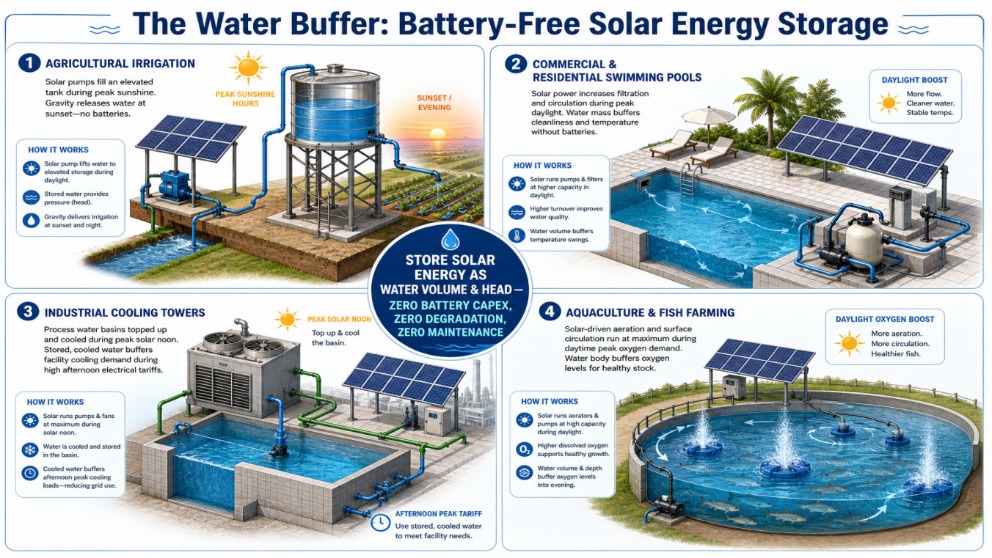
This approach decouples when energy is generated from when water is used—without the cost, maintenance, or complexity of batteries.
The water buffer also helps with demand charge management. By shifting pumping to solar hours, facilities reduce their grid draw during expensive peak periods.
Multi-Pump Systems and DC Microgrids
For facilities with multiple pumps, DC coupling enables a shared DC microgrid.
A single MPPT energy manager can feed a common DC bus that supplies multiple pump drives. Solar energy flows dynamically to whichever pumps are running.
Example: A campus with three circulation pumps—one for heating, one for cooling, one for domestic water. During midday, all three may run. Solar energy distributes across them. When one pump cycles off, the solar energy redistributes to the remaining active pumps. No waste. No complex switching.
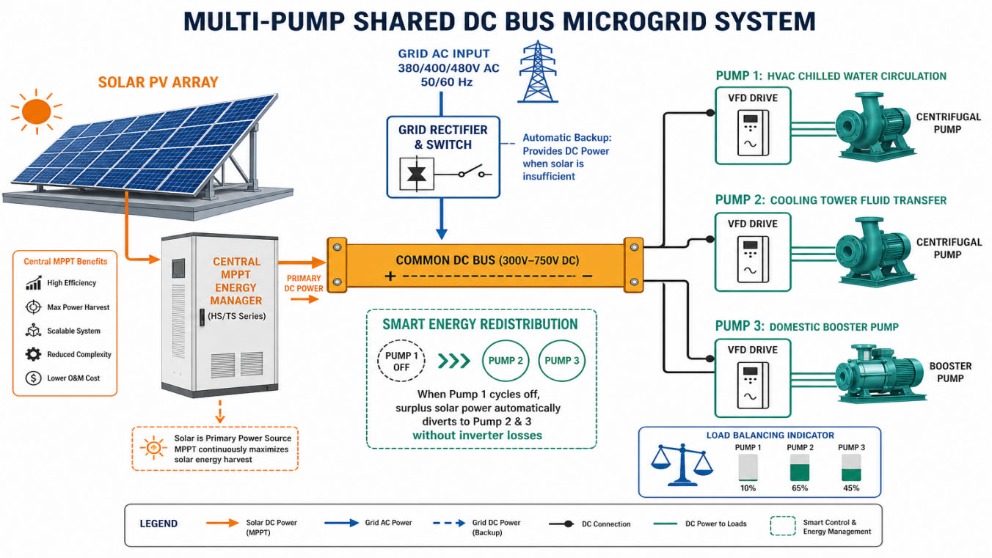
Some systems also implement pump rotation scheduling—alternating which pumps run to balance wear while maximizing solar utilization.
Engineering note: Multi-pump common bus configurations require proper electrical matching, protection, and isolation. Bus voltage, total power capacity, and protection schemes must be verified for each installation. This is not a plug-and-play parallel connection.
What to Check Before Specifying a Solar Direct-Drive Pump System
1. Pump drive DC bus accessibility – Does the VFD provide accessible DC bus terminals?
2. Bus voltage range – Does it match the MPPT energy manager's output?
3. PV string voltage – Does the array's operating window fall within the MPPT range?
4. MPPT power rating – Is it sized for the pump's power draw?
5. Duty cycle – How many hours per day does the pump run?
6. Minimum flow/head requirements – Can the pump tolerate speed variation without compromising process?
7. Water storage capacity – Is there a tank, reservoir, or pool to buffer energy?
8. Environmental protection – IP rating for the drive enclosure; corrosion resistance for wet environments
9. Local codes – NEC or local electrical requirements; disconnect and isolation compliance
FAQs
Q1: What's the difference between a DC-coupled solar pump and a conventional solar pump system?
A1: A conventional solar pump system uses a separate solar inverter to convert PV DC to AC, then the pump drive rectifies it back to DC. DC coupling eliminates that inverter—PV DC goes directly into the pump drive's DC bus through an MPPT energy manager. Fewer conversion stages mean lower losses and simpler hardware.
Q2: Do I need batteries for a solar direct-drive pump?
A2: Not in the basic configuration. The system runs on solar when available and switches seamlessly to grid power when solar drops. Batteries are optional for off-grid or backup requirements.
Q3: Can I retrofit an existing pump with solar DC coupling?
A3: Yes, if the existing pump drive has an accessible DC bus and compatible voltage. Many industrial VFDs are suitable. Verify with the drive manufacturer before proceeding.
Q4: What happens when a cloud passes over?
A4: The grid fills the gap instantly. Because the grid is connected to the same DC bus through the drive's rectification, the pump doesn't lose speed or pressure. The transition is seamless.
Q5: Which pump applications benefit most from DC coupling?
A5: Applications with long daytime run hours and some tolerance for speed variation: irrigation, pool circulation, cooling water, aquaculture aeration, and industrial circulation. Constant-pressure or constant-flow applications can also work—the grid handles short-term solar fluctuations.
Making the Switch
Pumping is one of the most energy-intensive operations in any facility. With full DC architecture, those pumps can become direct consumers of on-site solar—reducing grid dependence, lowering operating costs, and leveraging water itself as free energy storage.
The technology is proven. The path is straightforward. And for many facilities, the payback starts on day one.
Ready to evaluate a solar direct-drive solution for your pump system? Contact our engineering team with your pump specifications, operating hours, and site conditions—we'll help match the right configuration.