If you manage a factory, warehouse, or agricultural facility, you know the rhythm: ventilation fans run for hours—often days—at a time, pulling heat, moisture, and stale air out of large spaces. And those fans account for a significant chunk of your electricity bill.
What if the sun could power that airflow directly—without an inverter, without batteries, and without the conversion losses that come with traditional solar setups?
That's the promise of full DC architecture applied to industrial fans and ventilation systems. It lets solar energy feed directly into the fan motor drive's DC bus, skipping the wasteful "DC to AC back to DC" loop. The result: lower energy costs, simpler
installation, and ventilation that keeps running even when the grid gets shaky.
Here's what facility managers and engineers need to know.
Why Industrial Ventilation Is a Cost Problem Worth Solving
Ventilation isn't a luxury load—it's a productivity and safety load. Factories, warehouses, poultry farms, and greenhouses rely on continuous airflow to control heat stress, remove fumes, and manage moisture. But that airflow comes at a cost.
The numbers tell the story:
l Fans often run through peak heat hours when electricity is most expensive
l Large motors starting during busy periods drive up demand charges
l Many systems are oversized, wasting energy and accelerating wear
l Poor airflow design often leads to adding more fans instead of fixing the root cause
In other words: ventilation costs are high, but they don't have to stay that way.
What Is Full DC Architecture for Fans?
Most industrial fans are driven by AC induction motors. In a conventional solar setup, photovoltaic DC power gets inverted to AC, fed into the building's AC bus, and then rectified back to DC inside the fan's variable frequency drive (VFD). Each conversion adds cost, heat, and energy loss.
Full DC architecture changes the path:
Solar path: PV DC → MPPT energy manager (HS/TS) → DC/DC regulation → Fan drive DC bus → Motor
Grid backup: Grid AC → Fan drive internal rectification → Same DC bus → Motor
The photovoltaic string connects directly to the fan drive's DC bus through a DC/DC converter. The MPPT energy manager (like Eternal's HS/TS series) stabilizes the PV voltage to match the drive's bus voltage—illustratively around 390V DC, though actual values depend on the specific drive and system design.
This approach eliminates the separate solar inverter entirely. The fan drive's existing DC bus becomes the point where solar and grid power couple in real time.
How the System Works: Voltage Priority and Real-Time Coupling
The control logic is remarkably simple—and it's built into the physics of the system.
The MPPT energy manager stabilizes the solar-side output to a voltage slightly higher than the grid-rectified bus voltage.
When the sun is shining:
l Solar power is higher → PV energy takes priority, flowing into the bus and powering the fan
l Solar drops (clouds, evening) → Bus voltage trends downward; grid rectification fills the gap instantly
l No sun → The fan runs on grid power, just like a conventional AC fan
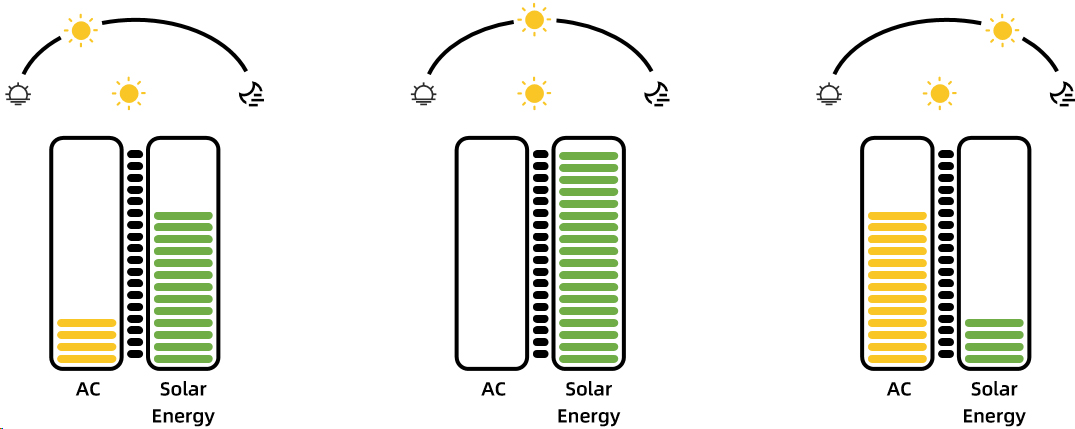
This is continuous power superposition, not a mechanical switch. The bus voltage itself determines which source supplies the load. And because the grid is always on standby, solar fluctuations don't translate into fan speed wobbles—the airflow stays stable.
No batteries required in the basic configuration. Storage is an optional add-on for backup or off-grid scenarios, not a prerequisite.
Why Ventilation Fans Are a Perfect Fit for DC Coupling
Industrial fans check all the boxes for full DC architecture:
1. They Run When the Sun Shines
Factories, warehouses, and livestock facilities need ventilation during daytime hours—exactly when solar generation peaks. The load profile matches the generation profile almost perfectly.
2. They're Already VFD-Driven
Most modern industrial fans—especially EC fans, variable-speed axial fans, and centrifugal fans—are driven by VFDs or permanent magnet motor drives. That means they already have a DC bus waiting for solar input.
3. Variable Speed Is Built In
Fans don't have to run at 100% all the time. With variable speed control, the fan can track available solar power—slowing down when clouds pass, speeding up when the sun is strong. This is especially valuable for ventilation loads where some airflow reduction is acceptable during short-term dips.
4. The Grid Provides Safety Backup
Critical ventilation—like poultry house cooling or fume extraction—can't stop when a cloud passes. The grid backup ensures uninterrupted airflow while still maximizing solar use.
Typical Applications
| Application | Fan Types | Why It Fits |
| Factory ventilation | Negative-pressure fans, axial fans, centrifugal fans | Long daytime run hours; high heat load |
| Livestock & poultry housing | Exhaust fans, tunnel ventilation fans | Continuous airflow needs; peak solar matches peak cooling demand |
| Warehouses & distribution centers | HVLS ceiling fans, EC fans | Large spaces; daytime occupancy |
| Greenhouses | Circulation fans, exhaust fans | Solar generation and ventilation needs align perfectly |
What About Multi-Fan Sites? The DC Microgrid Approach
One of the most practical benefits of DC coupling is sharing solar across multiple fans.
In a facility with several ventilation fans, a single MPPT energy manager can feed a common DC bus that supplies multiple fan drives. Solar energy flows to whichever fans are running at any given moment.
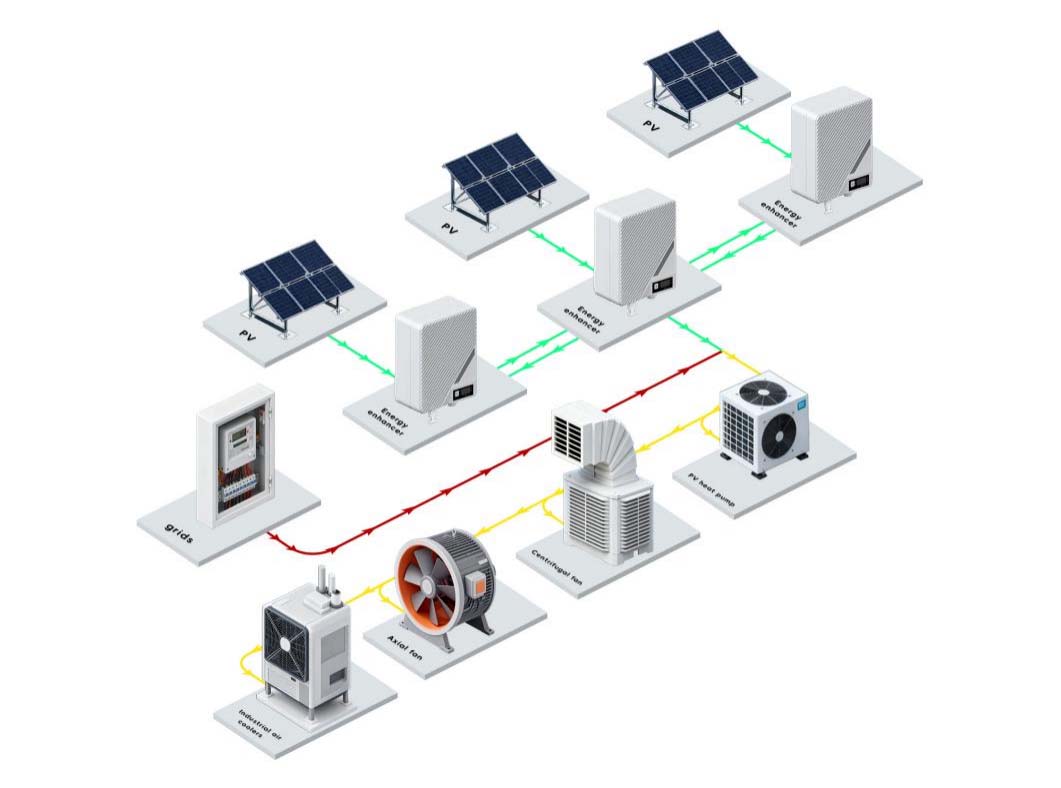
Real-world scenario: A factory has three ventilation zones with three separate fans. During mid-morning, only two zones need active ventilation. Solar energy automatically goes to those two running fans. When the third zone kicks in later, the solar energy redistributes—no waste, no complicated switching.
Key Benefits for Facility Operators
Reduced Energy Costs
A well-matched solar direct-drive fan system can reduce daytime ventilation electricity use by 30% to 60%. The savings come from three sources:
Direct PV consumption – Less grid electricity during peak rate hours
Lower conversion losses – No DC→AC→DC loop
Reduced peak demand – Large motors draw less from the grid during expensive periods
Simpler Installation
No separate solar inverter. No external rectifier cabinet. The fan's existing drive does the heavy lifting. In many cases, the installation is as straightforward as connecting the PV string through the MPPT energy manager to the fan drive's DC bus terminals.
No Mandatory Batteries
The basic system runs on solar + grid, with no battery requirement. This keeps upfront costs lower and eliminates battery maintenance. Batteries are only added when backup power or off-grid operation is a specific requirement.
Lower Maintenance
Fewer power conversion stages mean fewer components that can fail. The fan drive already has protection features built in; adding solar input doesn't introduce new single points of failure.
Resilient Ventilation
When the grid is unstable, the system can still run on PV—provided sunlight conditions meet the fan's startup requirements. In hybrid configurations, the microgrid controller can blend solar, grid, and other DC sources to maintain stable airflow.
Making the Switch
Industrial ventilation doesn't have to be a fixed cost you accept and move on. With full DC architecture, the fans that keep your facility comfortable and safe can also become a direct consumer of on-site solar energy—reducing grid dependence, lowering operating costs, and simplifying your energy infrastructure.
The technology is proven. The path is straightforward. And the payback? In many cases, it starts on day one.
Ready to evaluate a solar direct-drive solution for your facility? Contact our engineering team with your fan specifications, operating hours, and site conditions—we'll help match the right configuration.
FAQ
Q1: What's the difference between a solar direct-drive fan and a conventional solar-powered fan?
A1: conventional solar fan typically uses an inverter to convert PV DC to AC, then the fan's drive rectifies it back to DC. A direct-drive fan skips the inverter entirely—PV DC goes straight into the fan drive's DC bus through an MPPT energy manager. Fewer conversion stages mean lower losses and simpler hardware.
Q2: Do I need batteries for a solar direct-drive ventilation fan?
A2: Not in the basic configuration. The system runs on solar when available and switches seamlessly to grid power when solar drops. Batteries are optional add-ons for backup or off-grid needs.
Q3: Can one solar array power multiple fans?
A3: Yes—with proper engineering. A single MPPT energy manager can feed a common DC bus that supplies multiple fan drives. Solar energy distributes dynamically to whichever fans are running.
Q4: What happens when a cloud passes over?
A4: The grid fills the gap instantly. Because the grid is always connected to the same DC bus through the drive's internal rectification, the fan doesn't lose power or slow down noticeably. The transition is seamless.
Q5: Is this system suitable for retrofitting existing fans?
A5: Often yes. If the existing fan has a VFD or permanent magnet drive with accessible DC bus terminals, a solar MPPT energy manager can be added without replacing the fan. Verify bus voltage compatibility and consult the drive manufacturer before proceeding.
Q6: What types of fans work best with DC coupling?
A6: Any fan with a VFD or EC motor drive that has an accessible DC bus. Common examples include negative-pressure exhaust fans, axial fans, centrifugal fans, EC fans, and HVLS ceiling fans. The key requirement is the presence of a DC bus—not the fan type itself.