If you run a factory, a commercial building, or even a large home, you know the drill: air conditioning is your single biggest electricity expense during hot months. And ironically, the hottest days are usually the sunniest — meaning your AC load and solar availability peak at almost the same time.
Yet most solar air conditioning systems today still follow a wasteful path: convert solar DC to AC, feed it into the building, then let the AC unit rectify it back to DC again. Each conversion adds cost, heat, and energy loss.
What if the solar power could skip all that and go straight into the air conditioner's DC bus?
That's exactly what full DC coupling does. And the two biggest benefits — no mandatory batteries and no standalone inverter — are exactly what facility owners ask us about most.
Let's walk through how it works, what it saves, and where it makes the most sense.
What Is DC Coupling in a Solar Air Conditioner?
DC coupling doesn't mean the air conditioner has no AC input. It means solar energy no longer has to go through a separate inverter to become AC, only to be rectified back to DC inside the AC unit.
Instead, the solar path is simple and direct:
Solar path: PV DC → HS/TS MPPT Energy Manager → Regulated high-voltage DC → Air conditioner drive DC bus → Inverter stage → Compressor
Grid backup path: Grid AC → Air conditioner drive internal rectification → Same DC bus → Inverter stage → Compressor
The grid rectification module stays inside the air conditioner drive — no extra rectifier box needed outside. Solar and grid power share the same DC bus, and the control system simply allocates energy in real time: use as much solar as is available, and let the grid fill whatever's missing.
The global DC photovoltaic air conditioner market was valued at USD 848.92 million in 2025 and is projected to reach USD 2.59 billion by 2032 — a 17.32% CAGR. This rapid growth tells you something important: DC coupling for HVAC is no longer a niche concept. It's becoming the pragmatic choice for reducing operational energy costs.
Why DC Coupling Delivers Better Efficiency
1. A Shorter Path from Sunlight to Cool Air
Compare the two paths side by side:
Traditional AC coupling:
PV DC → Solar inverter AC → Air conditioner rectifies back to DC → Compressor
DC coupling:
PV DC → MPPT/DC-DC → Air conditioner DC bus → Compressor
By removing the "DC-to-AC-to-DC" loop, DC coupling saves the energy that would otherwise be lost in those extra conversion stages. Direct-drive systems that eliminate the inverter stage can improve overall system efficiency by an estimated 5% to 10%.
Actual savings depend on irradiance, load profile, and component matching — but the path itself is undeniably shorter.
2. MPPT Makes Every Photon Count
The HS/TS MPPT Energy Manager continuously tracks the maximum power point of your PV array. As sunlight changes throughout the day, the system keeps extracting whatever solar power is available — not waiting until solar fully covers the entire AC load before using it.
3. Grid Fills the Gap Without Compromising Cooling
When solar isn't enough, grid power steps in — not through a clunky switch, but by smoothly complementing on the same DC bus. The cooling stays stable, and you still save every watt of solar you can generate.
Do You Really Need Batteries?
Not necessarily. In fact, for many projects, the answer is no.
The basic DC coupling architecture consists of just four elements: PV panels, an MPPT energy manager, a compatible inverter air conditioner, and grid connection. Batteries are optional — not a requirement.
Battery-Free Works Best When:
Your cooling load is heavy during daytime hours (when solar is most available)
Your main goal is cutting daytime electricity costs
You have reliable grid backup for cloudy periods or evenings
You want lower upfront cost and minimal battery maintenance
When Should You Consider Adding Batteries?
Batteries become valuable when you need:
l Nighttime cooling
l Backup power during outages
l Peak shaving (reducing demand charges)
l Extended green power usage beyond daylight hours
Even then, the control strategy should follow a simple rule: solar goes to active loads first; only surplus goes to storage. This avoids the inefficiency of routing all solar power through batteries.
One Energy Manager, Multiple Air Conditioners: The DC Microgrid Concept
If you have several rooms, zones, or separate AC units, a single HS/TS energy manager can serve multiple air conditioner DC buses — forming a DC microgrid for cooling.
System topology:
PV → HS/TS MPPT Energy Manager → DC Energy Network → AC Unit 1 / AC Unit 2 / AC Unit 3 / Other compatible devices
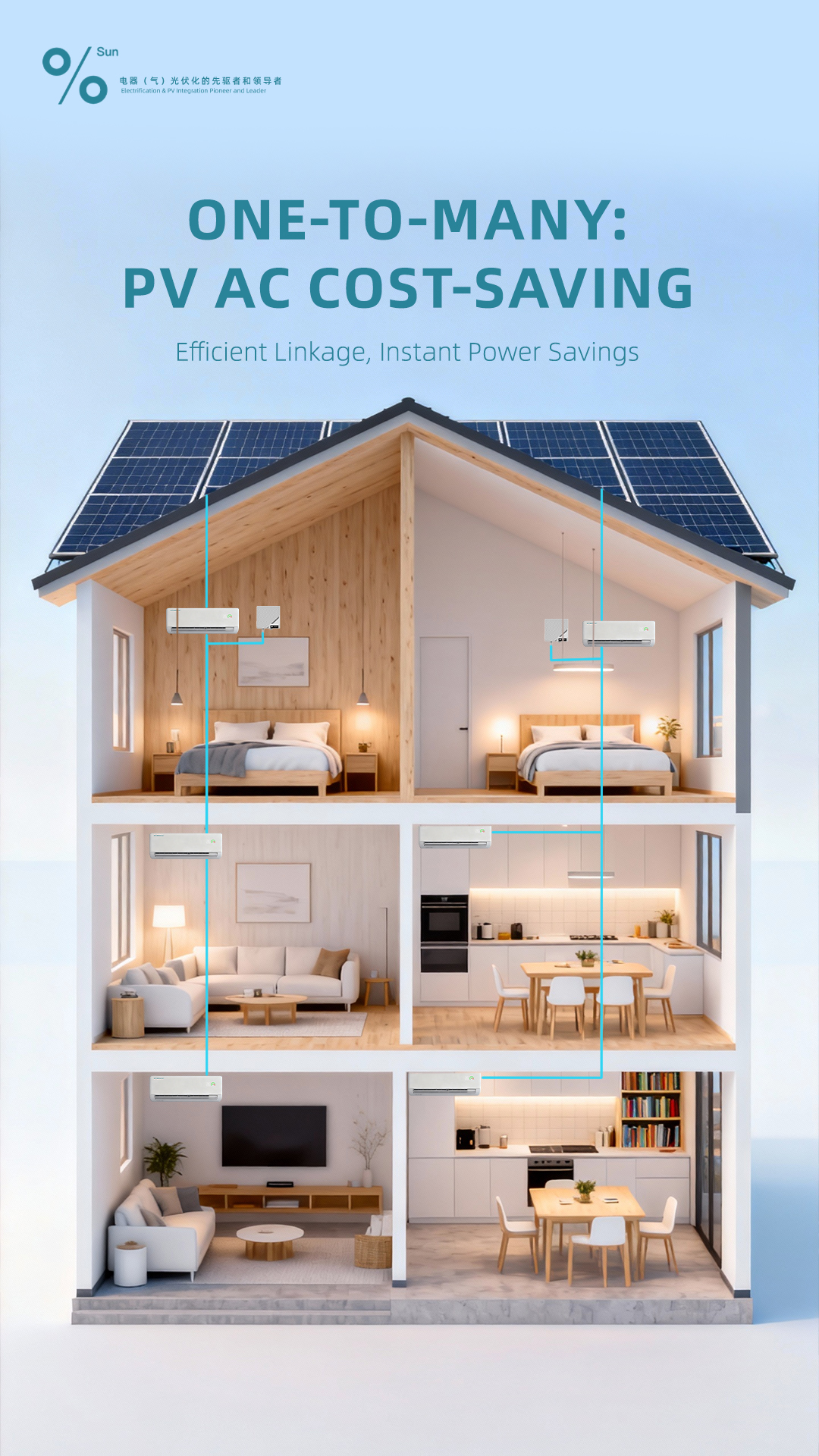
Solar energy flows to whichever unit is running at the moment. In a multi-room building, not all ACs run simultaneously. The system automatically directs available solar to active units — no need to oversize PV for every single unit.
Important note: "One-to-many" does not mean you can simply short all DC buses together. Each installation must verify bus voltage, total power, cabling, protection, isolation, and equipment compatibility according to product specifications and local codes.
Running on Pure Solar When the Grid Goes Down
This is where DC coupling really shines — especially in areas with unreliable grid power.
For compatible Eternal solutions with pure PV-following control, when the grid is down and no battery is installed, the HS/TS can still supply the DC bus — provided PV voltage and irradiance meet startup requirements. The compressor frequency adjusts in real time to match available solar.
What pure PV operation looks like:
| Condition | Compressor Behavior |
| Strong sunlight | Runs at higher frequency; maximum cooling output |
| Passing clouds / reduced irradiance | Frequency drops with available solar |
| Solar below minimum threshold | Ramp down, pause, or wait for restart (per protection logic) |
Whether a specific unit supports grid-free startup, minimum PV input requirements, and recovery behavior must be verified against the specific air conditioner model and energy manager configuration.
This capability is particularly valuable for:
l Frequent outage areas
l Weak or unstable grids
l Facilities that need basic daytime cooling regardless of grid status
How DC Coupling Compares to Other Solar AC Approaches
| Feature | DC Coupling Solar AC | AC-Coupled Solar | Traditional Off-Grid Inverter |
| Solar-to-compressor path | MPPT/DC-DC → AC DC bus | Invert to AC → Rectify back to DC | Battery → Invert to AC → Rectify to DC |
| Battery required | Optional | Usually not | Usually mandatory |
| Grid outage behavior | Compatible units run on PV | Grid-tied systems typically stop | Depends on battery capacity |
| Multiple units | Can form DC microgrid | Shared AC distribution | Constrained by inverter/battery |
| Reverse feed to grid | No | May be involved | No |
Where Does This Solution Make the Most Sense?
Multi-room residential with split inverter AC units
Shops, offices, schools, and small commercial spaces with daytime cooling loads
Factory offices, control rooms, and support facilities
Weak-grid or frequent outage areas needing daytime cooling
Phased projects starting with one AC unit and expanding later
Integrated projects combining AC, heat pumps, fans, or pumps into one PV network
What to Check Before You Start
A quick pre-design checklist:
1. Is your air conditioner a compatible inverter-drive platform with an accessible DC bus?
2. Does the drive bus voltage and power range match the HS/TS model?
3. What's your PV string configuration, voltage window, and installed capacity?
4. What's the simultaneous usage rate across multiple units?
5. What's the minimum startup power and protection strategy for grid-free PV mode?
6. Do you actually need storage — and if so, is the goal backup, night cooling, or peak shaving?
7. Have you verified DC isolation, surge protection, grounding, and local electrical codes?
A Simple Way to Think About It
DC coupling solar air conditioning is not about adding a complex generation system to an ordinary AC unit. It's about making the air conditioner itself a smarter energy node — one that can take solar energy directly, use grid power only when needed, and keep cooling your space with fewer losses, less equipment, and more flexibility.
For projects with high daytime cooling loads, limited battery budgets, or unreliable grid power, this architecture offers a practical, proven path.
Interested in exploring a DC coupling solution for your site? Share your cooling load, AC model, and site conditions — we'll help you evaluate the right configuration.
FAQ
Q1: Does DC coupling mean the AC runs entirely without grid power?
No. The grid remains the primary backup. The system uses solar first, then grid power when needed. On compatible units, it can also run on pure PV when the grid is down.
Q2: Can a battery-free solar AC work during a power outage?
Yes — for compatible Eternal solutions. The system powers the DC bus directly from PV and lets the compressor track available solar. Cooling output varies with sunlight, and the unit will ramp down or pause when solar drops below minimum operating conditions.
Q3: How many AC units can one energy manager support?
It depends on power rating, bus voltage, simultaneous operation rates, and protection design. The architecture supports 1-to-N configurations, but final capacity must be determined by specific engineering matching — not by unit count alone.
Q4: When should I consider adding batteries?
Batteries add value for nighttime cooling, outage backup, or peak shaving. If your main goal is simply reducing daytime electricity costs, batteries are not a prerequisite.
Q5: What's the difference between DC coupling and AC coupling in simple terms?
In AC coupling, solar goes DC → AC → DC again before reaching the compressor. In DC coupling, solar goes DC → DC straight to the compressor drive. One extra conversion stage is removed — that's the savings.